Safeguard Security Services

Unarmed Security Guards

Unarmed Security Guard Services

The gap between what you were promised and what you’re receiving is where most unarmed security guard services fail. We built our system to close that gap.

START SECURITY SERVICES TODAY
Licensed and Insured
BSIS Certified Guards
GPS-Verified Patrols
Real-Time Reporting
90% Retention Rate

Trusted by Clients Across Southern California

Rated Excellent on Google
90%
Client Retention Rate
24/7
Dispatch Monitoring
15 min
Max Checkpoint Delay
3-Layer
Supervision System
— On-Site Duties

What Unarmed Security Guards Actually Do When They're Managed Right

The difference between the average security guard and a professional, unarmed security guard shows up in the details of every shift. They may not be “major” problems at first, but they can slowly turn into issues. When professional officers get to work, they review the previous shift’s Silvertrac report, check the post orders for any updates, and begin a documented patrol within the first 15 minutes. That first patrol isn’t a casual walk; it’s a detailed check of every access point, stairwell, parking level, and common area on the property, with each checkpoint logged by GPS and timestamp.

On a standard 8- or 12-hour shift, our unarmed security officers cycle through patrol rounds every 60 to 90 minutes, depending on the property’s size and issues. Between rounds, they’re managing access control, verifying visitor credentials, logging deliveries, monitoring badge access at entry points, and handling whatever walks through the door. Tenant locked out at midnight? That’s the guard. Is the vendor trying to access the loading dock without authorization? That’s the guard. Noise complaint on the third floor? Also, the guard. Their duties and responsibilities change with each site.

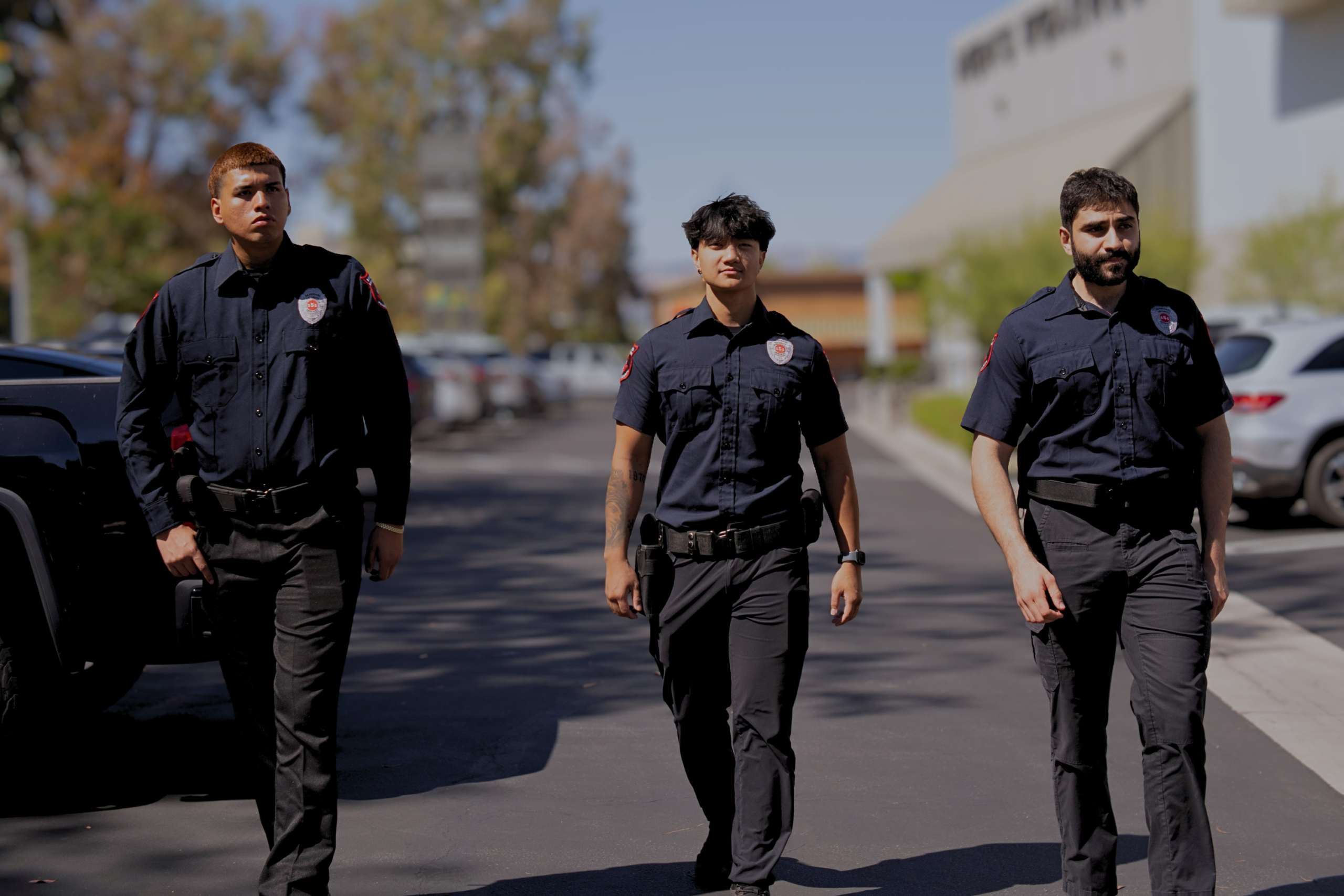
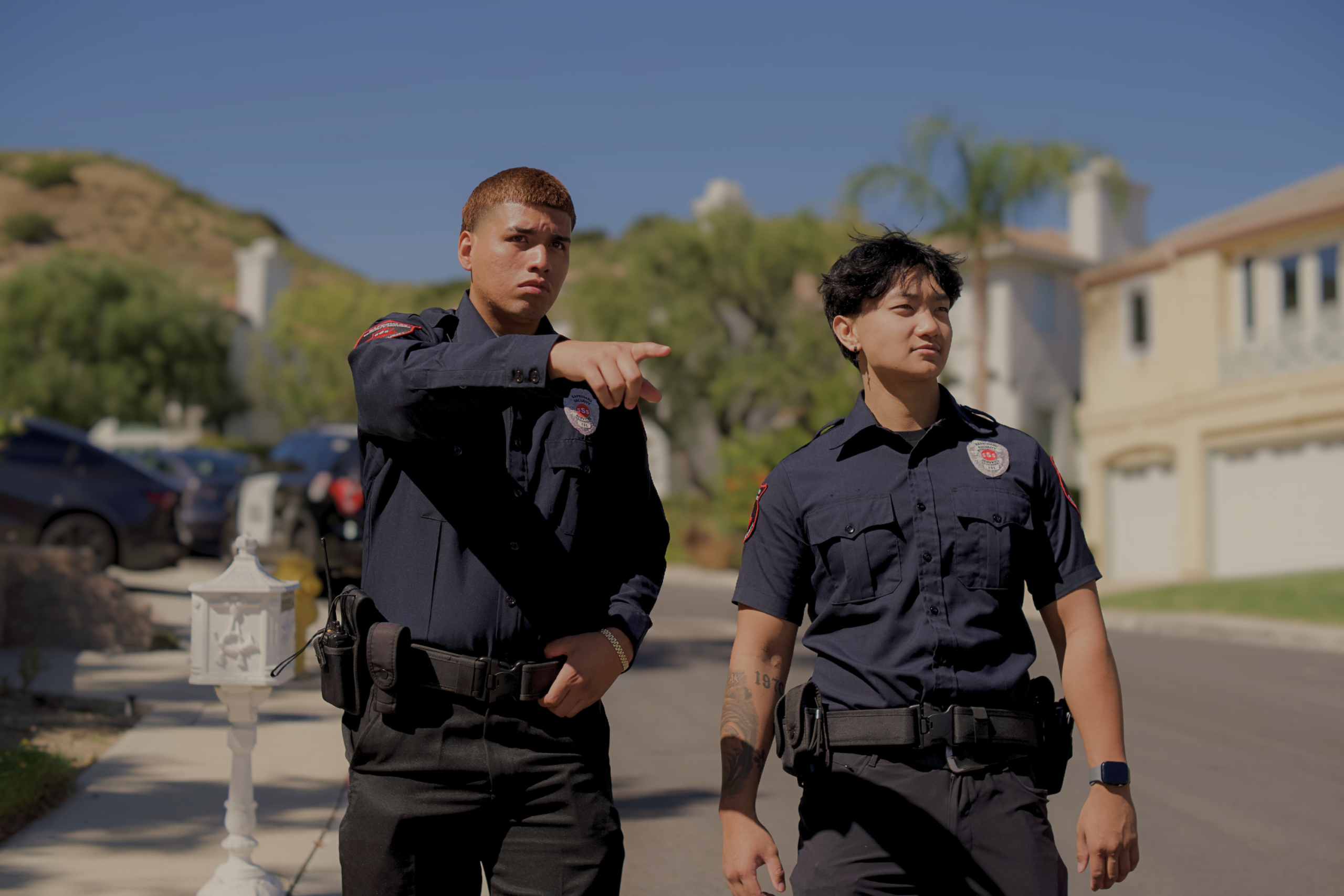
Professional unarmed security guards patrolling a Southern California apartment community

California requires every security officer to have a valid BSIS Guard Card, which involves a criminal background check and completion of 40 hours of mandated training within the first year, including courses on legal authority, public relations, and observation techniques. Our officers complete that full training cycle before their first shift. State requirements are not where we stop. We run internal training on de-escalation, customer service, report writing, and property-specific protocols. A guard who is a good fit at a warehouse may not have the skills for a medical office lobby where patients are anxious and families are upset. We match officers to assignments based on experience, not just availability.

The question property managers ask most about unarmed guard services is whether officers without firearms can handle real situations. The honest answer: a trained unarmed guard handles the majority of what commercial and residential properties face, including trespassing, unauthorized access, parking violations, loitering, tenant disputes, and after-hours disturbances through observation, verbal intervention, and controlled de-escalation. For sites where the risk involves armed threats, high-value cash handling, or documented violent incidents, unarmed coverage isn’t the right service level. We’ll tell you that upfront and recommend armed officers if that’s what the property needs.

Not sure if unarmed coverage is the right fit?

We’ll give you an honest assessment — even if that means recommending a different service level.

— Accountability

What Actually Separates a Professional Unarmed Security Company

What actually separates a professional unarmed security company from others is accountability. If a company doesn’t have a proper system to hold guards accountable, even the best security guards will start performing poorly. It is not always about the guards on-site but also the support, training, and management they receive from the company.

For instance, every patrol our guards run is logged through Silvertrac with GPS coordinates, timestamps, and activity notes. You access these reports from your own client portal without calling us and asking. If there are areas you specifically want checked, like a parking garage, a back gate, or a vacant unit, we install QR checkpoints so you can verify that exact spot was covered. We’ve built our system this way on purpose. By giving clients access to reports directly, we have to make sure our guards are doing reports on time. And when guards do reports on time, there are fewer chances of breaches and security issues.

Our dispatch team reviews incoming reports 24 hours a day. If a 2:00 AM checkpoint hasn’t been logged by 2:15 AM, dispatch calls the guard directly and finds out why. We don’t save problems for the morning. Field supervisors do random checks at all active posts, overnights, and weekends included, to make sure guards are complying with post orders, following company standards for uniforms, and making sure the guard is actually where they are supposed to be. That’s three layers of verification running on every shift. Most companies tell you they supervise their guards. Ask them to describe exactly how, and the conversation usually ends.

1

Silvertrac GPS Logging

Every patrol checkpoint logged with GPS coordinates, timestamps, and activity notes. Clients access reports directly — no phone calls, no waiting.

2

24/7 Dispatch Monitoring

If a checkpoint hasn't been logged within 15 minutes, dispatch calls the guard directly. Problems don't wait until morning.

3

Random Field Supervisor Visits

Unannounced site visits during all shift periods — overnights and weekends included — confirming post-order compliance and uniform standards.

The accountability test: Most companies tell you they supervise their guards. Ask them to describe exactly how, and the conversation usually ends.
— Coverage Models

How Patrol Routes and Coverage Differ by Property Type

Foot patrol security isn’t one-size-fits-all. The security plan for a 200-unit apartment complex is different from a single-tenant warehouse or a mixed-use building with ground-floor retail and offices above it.

Commercial Properties

Patrol routes built around access points, parking structures, and common areas. Officers check entry doors, stairwell access, and elevator lobbies every hour. Parking structure patrols happen more frequently. We randomize checkpoint timing so routes can't be predicted.

Residential & HOAs

Gate access verification, visitor logging, and amenity area rule enforcement. Summer months add pool and common area checks — verifying wristbands, enforcing guest limits, addressing noise complaints. Officers selected for customer service and communication skills.

Industrial & Logistics

Perimeter checks, loading dock access, and credential verification. Distribution center post orders include checking gate access, logging trailer movements, and running perimeter checks on 10- or 12-hour overnight shifts.

The coverage model we recommend always starts with a site walk. Some properties need a standing guard at a fixed location during peak hours and a roving patrol overnight. Others need 24/7 unarmed security with a separate roving patrol. We build the plan around what the property actually needs, not a template.
— Getting Started

What the First Week Looks Like When You Hire Safeguard

For property managers ready to move forward, here's how working with Safeguard looks like:

1

Site Walk

We start with a site walk. One of our operations managers visits your property, reviews every access point and patrol zone alongside you, and documents vulnerabilities, broken gates, blind spots in parking areas, unsecured secondary entrances, and lighting issues. If you are not available for a site walk or just want quick pricing, then we have a list of questions we ask to provide you the most accurate quote. Regardless, a security company that sends you a quote before walking your site or asking you all the necessary questions is guessing. We don't guess.

2

Custom Post Orders & Guard Selection

When the site assessment is done, we create custom post orders and a security plan matched to the property's layout. Guard's assignments are based on property type and experience. A retail location needs an officer with strong public interaction skills. A warehouse needs someone experienced with perimeter control and vehicle gate management. These aren't the same.

3

Transparent Pricing & 30-Day Trial

We provide a clear, itemized pricing sheet with every proposal that includes hourly rates, overtime structure, supervisor costs, and any other fees broken out separately. No hidden charges, no bundled line items you can't decipher. And we start every new client with a 30-day trial contract. If our service doesn't meet your standards within that first month, you leave with no strings attached. We prefer earning partnerships to demanding them from the start.

4

First Shift & Ongoing Reporting

The first shift includes an on-site briefing between the assigned officer, a field supervisor, and your property contact. The supervisor walks the post with the guard, reviews every section of the post orders, and confirms protocols. In the beginning, our supervisors check in more regularly to make sure everything goes smoothly, but as the guards learn site orders and get familiar, we start implementing randomized check-ins instead. Silvertrac reports start on day one as well with patrol logs, timestamped reports, and checkpoint confirmation.

Looking for unarmed security guard services for your property?

The right first step is a site walk and a direct conversation about what you actually need. We’ll schedule that walk within the week — no commitment, just a professional evaluation and an honest recommendation.

— FAQ

Frequently Asked Questions About Unarmed Security Guards

Yes, under California’s citizen’s arrest laws. If your guard directly witnesses a crime like theft, vandalism, or trespassing, they can detain that person for a reasonable amount of time until law enforcement shows up. What they can’t do is use excessive force, search without consent, or hold someone without probable cause. Our security guards are trained on the legal boundaries of detention and de-escalation. They follow what is within the law and reduce your liability exposure.

Security guards are private citizens, not law enforcement. They can observe, report, control access, ask individuals to leave private property, and perform a citizen’s arrest if they witness a crime. They can’t do searches without consent, make formal arrests, or carry firearms without a proper BSIS permit. Our guards are trained on these matters, which protects your property and keeps you out of legal trouble.

This is one of the most common frustrations property managers bring to us. If your current provider can’t show you timestamped, GPS-verified patrol logs on demand, you don’t actually know. With Safeguard, every checkpoint is logged through Silvertrac with GPS coordinates and timestamps. You can access reports through your portal without requesting them from your account manager; no phone calls, no waiting. We also install QR checkpoints at specific locations you want verified, so you can confirm those exact spots were patrolled.

Unarmed guards in Southern California typically bill between $28 and $40 per hour, depending on shift timing, post complexity, and property type. Armed guards cost significantly higher, usually $40 to $65+ per hour, due to additional firearms licensing, training requirements, and higher insurance costs. For most commercial, residential, and industrial properties, unarmed coverage handles the threat profile effectively at a lower cost. We’ll tell you upfront if your property actually needs armed officers. Our advice is to avoid cheap security companies because they’ll cost more in the long run. We also wouldn’t suggest the expensive side unless you need special training or have specific requirements.

California requires all security officers to maintain a valid BSIS Guard Card, which involves a criminal background check and completion of 40 hours of mandated training within the first year. That training covers legal authority, public relations, observation and reporting techniques, and the power to arrest. Our officers complete the full training cycle before their first shift, and we add internal training on de-escalation, customer service, report writing, and property-specific protocols on top of state requirements.

In most cases, commercial and residential properties face issues such as trespassing, loitering, unauthorized access, tenant disputes, and noise complaints, and trained unarmed officers can take care of them through verbal de-escalation and controlled presence. They don’t need a weapon to remove an unauthorized person from a loading dock or de-escalate a confrontation in a lobby. If your property’s threat profile includes armed threats or documented violent incidents, we’ll recommend armed officers instead. We’d rather give you an honest assessment than sell you the wrong service level.

Three layers. First, every patrol checkpoint is GPS-logged in Silvertrac. If a guard misses a report or is late by more than 15 minutes, our dispatch team calls the guard directly. Second, our field supervisors do unannounced site visits during all shift periods, including overnights and weekends. Third, you have real-time access to patrol reports through your client portal, so you can see activity logs yourself. Most companies say they supervise overnight shifts. We can show you the data to back up our claim.

Ask your prospective company three things: how exactly do you supervise guards, can I see reports in real time, and what happens when a guard misses a checkpoint? If they can’t give you specific answers to those questions, you’ll end up with the same problems you’re leaving behind. Other things to look for are documented post orders (not verbal instructions), GPS-verified patrol tracking, a dedicated account manager, and a willingness to start with a trial period. We start every client with a 30-day trial contract because we’d rather prove ourselves than lock you into a commitment.

It depends on your property’s layout, risk level, and budget. A standing guard makes sense for commercial properties, construction sites, and medical offices during business hours. Mobile patrols work if your property doesn’t face significant issues, but you just need someone to open the gates in the morning and close them at night or enforce HOA and parking rules in apartments and communities. If you’re not sure what works better for you, contact us, and we’ll help you evaluate it.

It depends on every company. We take about three to five days to do a site walk, create post orders, assign guards that are good fits for your specific needs, set up the client portal, install the QR codes, and assign an account manager.

Ready to See the Difference Professional Security Makes?

Start with a free site walk. No commitment. Just an honest evaluation and a clear recommendation.